Boston Scientific Has to Keep Buying the Future

Upcoming posts (in no particular order): Gartner, Visa/Mastercard, Tractor Supply, Waystar, CCC, and OTC Markets
Correction: In my U-Haul post from July 10th, I observed:
…utilization has been declining for decades, the downward trend interrupted only by brief, one-off reversals like the post-GFC recovery and the COVID surge.
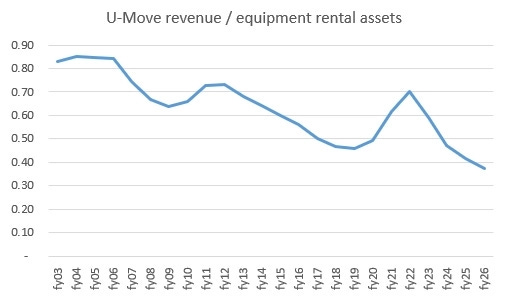
(U-Move refers to the equipment rental business)
Some of this might be explained by U-Haul continuously investing ahead of demand, but surely not all of it. Dividing rental revenue into rental assets with a one or even two year lag produces a similar downward trend. And if you divide fy26 U-Move revenue into U-Move assets from fy24, the result is still much lower than the quotient from a decade ago.
A reader pointed out to me that in the past, U-Haul leased a far greater proportion of their equipment assets than they do today, which means the company was recognizing revenue from equipment that was not accounted for as an asset on the balance sheet and thus, not accounted for in the denominator (”equipment rental assets”) in the above exhibit. When those leases are capitalized at 7.5x and included, the time series looks like this:
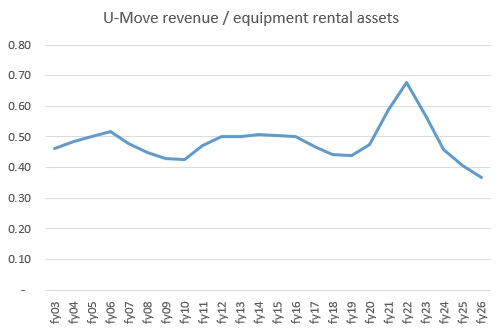
So, in fact, utilization has not been trending down for a long time. It was more or less flat from fy03 through fy20, when it spiked briefly, before collapsing below the long-term trend. Apologies for the error.
Boston Scientific’s roots reach back to 1969, when Medi-Tech introduced steerable angiography catheters – thin, flexible, hollow tubes that doctors thread through blood vessels to see where they are narrowed or blocked – one of the first tools in the nascent category of what management today describes as “interventional medicine”, where diseases are treated with small devices and small incisions rather than open surgery or drugs. John Abele, a President at Medi-Tech, and his friend Pete Nicholas, a Wharton MBA, founded Boston Scientific in 1979 to buy Medi-Tech, the first of many acquisitions to come.
A full accounting of these transactions is beyond the scope of this post. Suffice it to say that through a flurry of roll-ups and $billion+ transformative deals throughout the ‘80s and ‘90s, Boston cobbled together a vast portfolio of products that could reach problem areas through small vessels and tracts – tiny metal filters that catch blood clots traveling from the legs before they reach the lungs; tools that measure the volume of blood being pumped by the heart; flexible camera tubes that look inside the digestive tract (gastrointestinal endoscopy) or lungs (pulmonary endoscopy); devices that pass through the tubes to cut tissue, stop bleeding, remove polyps, place stents, and drain fluid; angioplasty balloons, mounted on catheters, that thread into constricted blood vessels and inflate, restoring blood flow to legs or clearing the way for stents; catheters that diagnose and treat abnormal electrical signals in the heart; catheters that treat blood vessels in the brain and neck, preventing strokes and brain aneurysms (neurovascular intervention). All kinds of stuff!
But notwithstanding its broad product portfolio and anatomical reach, by the early 2000s Boston Scientific’s fortunes were heavily tied to coronary stents, tiny mesh tubes that a doctor props open inside a clogged artery, allowing blood to flow more easily. The body would see these “bare-metal” stents as a kind of wound and generate scar-like tissue that sealed them into the vessel walls, as intended. But for a large minority of patients, too much scar issue formed, re-clogging the very artery that stents were designed to open.
The fix was to coat the metal mesh with a drug that would slowly release into the surrounding vessel wall, calming the healing response. These drug-eluting stents (DES) rapidly overtook bare-metal stents as the standard of care. Boston Scientific’s internally developed product, TAXUS, reached the US market in 2004 and soon surpassed J&J’s Cypher, which was released a year earlier, becoming Boston’s largest revenue contributor by far:
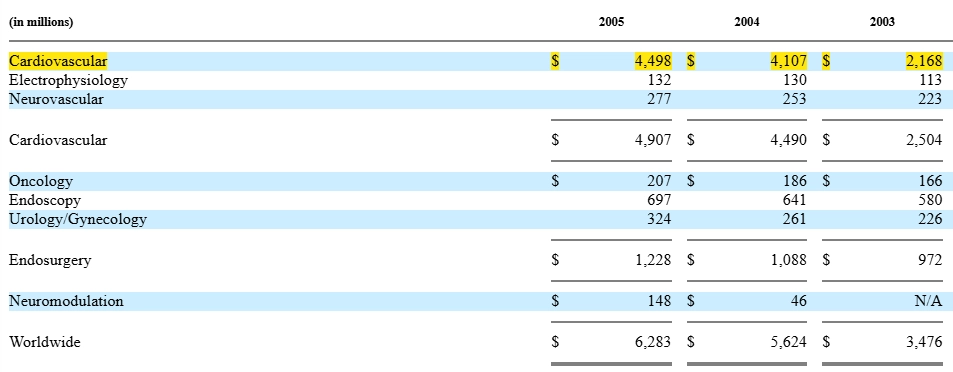
Between 2003 and 2005, Boston’s Cardiovascular revenue more than doubled, from $2.2bn to $4.5bn, with TAXUS accounting for close to 80% of that increase.