U-Haul Bought at the Top

Upcoming posts (in no particular order): Gartner, Visa/Mastercard, Tractor Supply, Boston Scientific, CCC, and OTC Markets
A correction is warranted to this U-Haul post, where I observed the following:
…utilization has been declining for decades, the downward trend interrupted only by brief, one-off reversals like the post-GFC recovery and the COVID surge.
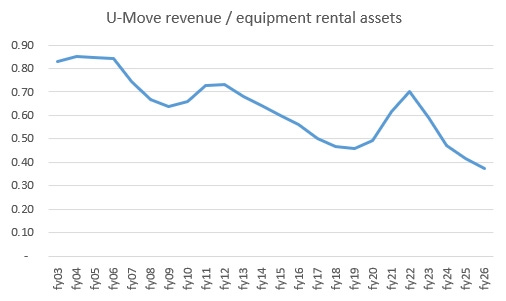
(U-Move refers to the equipment rental business)
Some of this might be explained by U-Haul continuously investing ahead of demand, but surely not all of it. Dividing rental revenue into rental assets with a one or even two year lag produces a similar downward trend. And if you divide fy26 U-Move revenue into U-Move assets from fy24, the result is still much lower than the quotient from a decade ago.
A reader pointed out to me that in the past, U-Haul used to lease a far greater proportion of their equipment assets than they do today, which means the company was recognizing revenue from equipment that was not accounted for as an asset on the balance sheet and thus, not accounted for in the denominator (”equipment rental assets”) in the above exhibit. When those leases are capitalized at 7.5x and included, the time series looks like this:
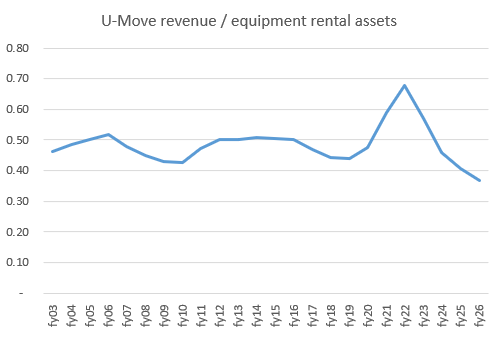
So, in fact, utilization has not been trending down for a long time. It was more or less flat from fy03 through fy20, when it spiked briefly, before collapsing below the long-term trend. Apologies for the error. (Jul. 16, 2026)
For many companies, the COVID era is by now a distant memory. Not U-Haul. The choices it made in that period still linger today. Just before the pandemic, management was drawing criticism for growing the fleet of trucks and vans even as utilization kept deteriorating. Then COVID drove a wave of do-it-yourself moves out of dense cities, and U-Haul’s prior-year investments looked prescient as revenue per truck and equipment spending spiked. Encouraged by the surge in demand, U-Haul continued buying, but did so at escalating prices. Truck shortages caused by pandemic-induced production disruptions were soon exacerbated by Ford’s and GM’s push toward EVs. CEO Joe Shoen accused automakers of pushing through 30% to 50% price hikes on ICE trucks and vans to subsidize the government’s EV agenda, and dismissed EVs as a substitute for ICE vehicles, calling them a “total non-starter” for the operational realities of the moving business.
To Shoen’s relief, Ford and GM, after losing boatloads of money, scaled back their EV initiatives, the retreat hastened by the retraction of various EV-friendly subsidies and regulatory measures under Trump. With OEMs pivoting production back to ICE vehicles, shortages have finally eased and prices have normalized. This is good for current vehicle purchases but bad for vans and trucks that U-Haul bought at much higher prices years earlier.
At a high level, the way depreciation accounting works for equipment purchases is that I buy a truck for $100 with the expectation that after 8 years, I can re-sell it for $20. Assuming a straight-line schedule1, I depreciate the $80 difference between the purchase price and the expected resale value evenly over that period, recognizing $10 in depreciation expense every year ($80 divided by 8 years) until I dispose of the vehicle, at which point I recognize the difference between the sales price and the book value of the vehicle as a gain or loss on the income statement. After 8 years, if I sell the vehicle for $30, I report a $10 gain; if i sell it for $10, I report a $10 loss. At any time until then, if my terminal year resale estimate goes up, my depreciation expense goes down and vice versa.
Well, back when U-Haul was buying trucks and vans at elevated prices, it expected to re-sell them at elevated prices too. But with OEMs now pricing new vehicles lower, resale values are being dragged down in turn, forcing U-Haul to either sell old equipment at a loss, or mark down the resale value it had been assuming, raising annual depreciation expense. Or some combination of the two.
As a result, the depreciation expense on rental equipment has climbed, from 13% of revenue in fy22 to 23% in fy26, while gains on equipment sales have flipped to significant losses:

(fy20 = year ending March 31, 2020)
This has taken U-Haul by complete surprise. The company typically marks its fleet conservatively, evidenced by the fact that in every fiscal year going back to at least 2010 it has realized gains on non-real estate disposals. Management says they have not seen new prices coming persistently below old prices like this at any point in the last 15 years. The adjustment in depreciation expense has been especially intense for cargo vans, which are today coming onto the books at an average cost 12% lower than last year and ~20% lower than 2 years ago, and are depreciated over just 1 to 2 years compared to a box truck’s 8 years. Operating margins2 in U-Haul’s Moving & Storage segment, which includes the self-storage business, have collapsed in recent years: