Veeva, AI, and regulated workflows

I recently recorded my annual podcast interview with @LibertyRPF, where I offer some thoughts on the market and the business of newsletters. Enjoy! (Spotify, Apple, YouTube)
A lot has happened since I wrote up Veeva nearly five years ago. At the time, Veeva, the dominant biopharma CRM, remained locked in a bitter dispute with IQVIA, the dominant vendor of data related to healthcare professionals and organizations (OneKey). The conflict dates back to 2016, when IQVIA blocked pharma customers from uploading its data into Veeva’s data management and analytics products (Network and Nitro, respectively), in turn diminishing the utility of Veeva’s CRM. Veeva, in turn, blocked IQVIA from pulling data out of its EDC system, the software used to capture and manage patient data during clinical trials. Veeva sued IQVIA on anti-trust grounds; IQVIA sued back, alleging unlawful use of data. The clash frustrated pharma customers, who wanted to freely combine IQVIA’s data with Veeva’s software.
Each responded by building its own version of the other’s core functionality. IQVIA elbowed its way into CRM through various acquisitions….Incentia, 360 Vantage (which, like Veeva CRM, was built on force.com), Apparture, Cegedim, and finally another force.com-based solution called Orchestrated Customer Engagement (OCE).
Veeva, meanwhile, began building its own “Data Cloud”, composed of four major pillars:
1) OpenData: a continuously maintained dataset of healthcare professionals – contact details, specialties, and hospital affiliations – scraped from hospital websites, online directories, and other public sources.
2) Compass: anonymous, longitudinal data on US patient prescriptions, procedures, and diagnoses, used to segment and target HCPs and alert sales reps to changes in prescribing behavior.
3) HCP 360: expands on OpenData by adding behavioral and consent data – how do doctors want to be reached? how often do they participate in webinars? which medical topics do they engage with? – so that reps know who they are allowed to reach out to and through what channels.
4) Veeva Link: a “curated LinkedIn on steroids”, Veeva Link pulls data from PubMed, social media, hospital websites, and clinical trial registries to map out more than 1mn key scientific and medical influencers across different therapeutic areas and show how they’re connected.
Crossix, acquired by Veeva in 2019 for $550mn, is also part of the broader data estate – providing longitudinal datasets of prescriptions, claims, and clinical data on more than 300mn patients – but is more commonly treated as a marketing analytics layer that integrates with the other four data sets to measure media spend and target digital ad placement to life sciences audiences. For instance, it can link TV ad exposure to subsequent specialist visits and therapy starts, or connect a patient’s visit to a branded website back to their physician and trigger a notification to the pharma rep assigned to that doctor.
Data is often considered the lifeblood of enterprises, even stickier than the CRM and MDM it flows through, since replacing it means reworking countless downstream systems. But aggregating and curating it requires a different skillset than building software and IQVIA’s repeated attempts to create a rival CRM ultimately concluded on a low note in April 2024, when management agreed to license its OCE CRM software to Salesforce:
As part of the expanded partnership, IQVIA will license the OCE CRM related software to Salesforce, and the parties will collaborate to accelerate development of Life Sciences Cloud for customer engagement expected to be available in 2025. IQVIA will continue to market the OCE CRM product and will support its nearly 400 global OCE customers in 130+ countries through 2029. IQVIA will work with Salesforce to jointly market the new offering.
With IQVIA no longer competing with Veeva in software, both companies settled all lingering legal disputes and struck long-term partnership agreements, allowing the more liberal use of IQVIA’s data in Veeva’s software and vice-versa, reopening for Veeva commercial opportunities that had been curtailed by its lack of access to IQVIA's must-have datasets.
Yet, in retreating from CRM, IQVIA simultaneously breathed life into Salesforce as a competitor to Veeva while simultaneously positioning itself as the mission-critical data provider to both. Veeva, inversely, pitched its software as the center of gravity, with datasets – its own, IQVIA’s, and others’ – as interoperable complements that customers could mix and match at their discretion.
And the bargain was hardly symmetrical. Notice that while IQVIA abandoned its CRM ambitions, Veeva didn’t return the favor. It pushed on in data and made far more progress here than IQVIA ever made in software. Crossix, in particular, has been a standout, more than tripling its revenue since acquisition and now growing at roughly 30% annually, driven by surging demand for online audience targeting. Management believes it could eventually rival Veeva’s CRM business in size by 2030.
But even as Veeva worked to develop datasets in-house to reduce its dependence on IQVIA, its CRM was still not entirely its own, built as it was atop Salesforce Lightning. In time, Veeva created its own underlying chassis, Veeva Vault, which enabled all apps built on it to share data, content, and workflows, prefiguring an ambitious push toward a unified architectural foundation that could serve as a single source of truth from drug development through commercialization. Management began by migrating its R&D-related software to Vault, then in 2023 ported CRM to the platform as well. Freed from Salesforce Lightning’s restrictive architecture, Veeva could build out new commercial modules, like Campaign Manager (running and measuring digital marketing campaigns), Service Center (viewing interactions with HCPs), and Patient CRM (tracking patient enrollment and verifying benefits).
In short, Veeva historically faced two barriers to its commercial offerings. The first, IQVIA’s data use restrictions, limited its use industry-standard datasets. The second, an OEM agreement with Salesforce, stymied the development of certain applications. With both obstacles now removed, there is nothing holding Veeva back from reaching its full commercial potential.
Well, nothing technical at least. Migrating from Salesforce-supported CRM to Veeva’s re-platformed version, Vault CRM, is still a heavy and costly lift for customers. Veeva insists that clients who choose Salesforce are in for a riskier and even more burdensome transition, arguing that its rival’s life sciences CRM is an immature product with few reference customers that requires extensive, region-specific customization. But Veeva has already lost several large clients to Salesforce and expects to retain just 14 of the top 20 biopharmas when it previously claimed 18, suggesting that some clients prefer a more bespoke solution, are drawn to Salesforce’s extensive support ecosystem, or find themselves swept up in its exuberant AI messaging.
Apart from facing direct competition from a formidable rival, Veeva must also contend with the reality that CRM is no longer the growth opportunity it once was. It already commands more than 80% of biopharma CRM – closer to 70% once the Vault CRM transition runs its course – leaving little room to grow from share gains alone. Meanwhile, the clients it serves have trimmed their sales forces by nearly 10% over the past several years, and AI-driven productivity gains could spur even further reductions at some point.
Given that context, management is quick to downplay CRM’s importance to Veeva’s future. A stable, deeply penetrated offering with limited growth prospects, CRM is going being overtaken by Veeva’s other product lines, falling from 75% of total revenue a decade ago to just 20% today, and expected to reach 10% by 2030.
Veeva’s growth is increasingly powered by two other clouds – Development Cloud and Quality Cloud – which organize content and streamline workflows tied to drug development. Like Commercial Cloud (sales and marketing software) and Data Cloud (Veeva’s proprietary datasets), both are built on the Vault platform.
(Data Cloud may eventually have broader integrations with Veeva’s R&D apps but, for now, it primarily goes hand-in-hand with Commercial Cloud. In fact, Veeva reports Commercial Cloud and Data Cloud under a single reporting segment, Commercial Solutions, that comprises ~47% of total subscription revenue).
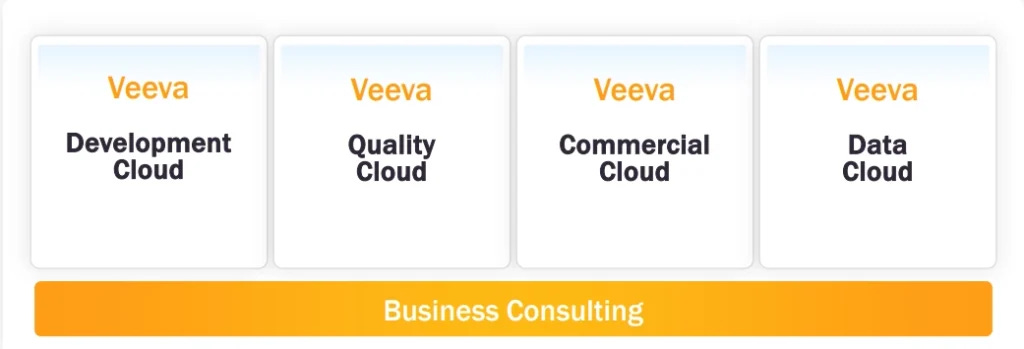
The above image belies the sprawl of Veeva’s offerings. Each of these 4 pillars contains suites and each suite contains applications, more than 50 in total, in varying stages of maturity. Wrapped cross it all is a business consulting service that helps clients integrate these components into a coherent life sciences cloud.
The sheer number of Development and Quality apps and the alphabet soup of acronyms assigned to them is enough to confuse even a diligent analyst. Rather than cataloguing each offering in isolation, it’s more instructive to walk through a typical clinical trial workflow and see where they slot in along the way (product names in bold).