[scuttlebit] Thermo Fisher update

MBI and I recorded an episode of Never Sell recently (AI Doom, Veeva, Research and Writing) (Spotify, Apple, YouTube, RSS feed)
Upcoming posts (in no particular order): Upwork, Adyen, PayPal, Gartner, Verisk, maybe Visa/Mastercard
As discussed in last week’s scuttlebit, Danaher’s life sciences coverage can basically be boiled down to 3 types of products: 1) diagnostic instruments and assays that hospitals and labs use to identify diseases, 2) research instruments and consumables that scientists use to study those diseases and discover drugs to fight them, and 3) tools and equipment that CDMOs and biopharmas use to manufacture those drugs. Thermo Fisher, nearly twice Danaher’s size by revenue, envelopes even more of the life sciences space. Whereas Danaher limits itself to products, Thermo Fisher provides services as well, running clinical trials on behalf of biopharma clients and manufacturing drugs for them too.
Here’s a run-through of what’s been happening in each of Thermo’s division over the last several years:
Life Sciences
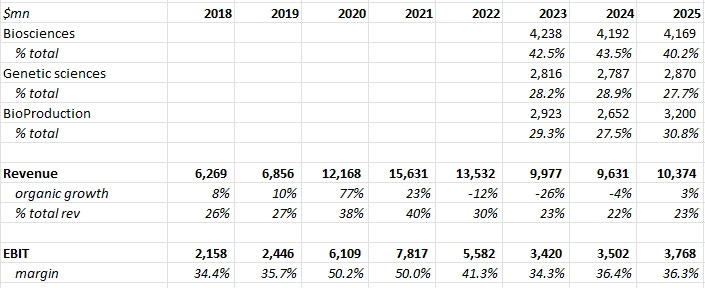
The Life Sciences segment, created through the $15bn acquisition of Life Technologies in 2014, is made up of 3 business units: Biosciences, Genetic Sciences, and Bioproduction.
Thermo’s bioproduction business is much smaller than Danaher’s in both absolute terms (~$4bn1 vs. $6bn) and as a percentage of total revenue (9% vs. 25%). It boasts a strong position in cell culture media (nutrients that keeps cells alive and productive in the bioreactor) and single-use technologies (disposable bags and tubes), and maintains a decent, though not leading, presence in purification (chromatography resins and columns that isolate proteins of interest). Last year’s $4bn acquisition of Solventum’s Purification and Filtration division plugs the gap between those two steps, adding filtration technologies that remove cells and debris from the harvest before purification begins.